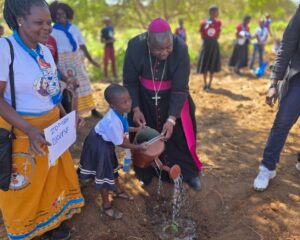
Rt. Rev. Alfred Chaima and a child from the Catholic Diocese of Zomba water a tree, embodying the spirit of stewardship for creation.
The President of the Malawi Conference of Catholic Bishops (MCCB), Bishop Martin Mtumbuka, has highlighted the importance of educating children on environmental conservation.
The call has been made earlier today, 02 August 2025, at the ongoing the National Children’s Congress at Don Bosco Parish in the Catholic Archdiocese of Lilongwe, where environmental education was the day’s focus.
According to Bishop Mtumbuka, this initiative is part of the response to a letter written by the late Pope Francis entitled “Laudato Si,” which urges the Church to take an active role in environmental stewardship.
“The late Pope emphasized care for creation. By involving children in activities like tree planting, we want to instill in them the importance of protecting nature, as they are the future leaders who will be most affected by climate change,” said His Lordship Mtumbuka.
Bishop Mtumbuka leads by example, planting a tree to teach children about environmental conservation
On the matter of education, His Lordship expressed concern over the challenges children presented to them regarding accessing quality learning.
He stressed the need for government intervention and broader responsibility from all sectors to address this.
Bishop Mtumbuka affirmed the Catholic Church’s ongoing commitment to ensuring high-quality education for children nationwide.
In his remarks, Ruben Chifundo Nazombe, Acting Director of the Jesuit Center for Ecology and Development, commended MCCB through the organizing committee for also considering environmental education to children, during this Congress.
Nazombe emphasized that this is an ideal time to offer environmental education so that children grow up with a sense of responsibility for nature in their communities.
After completing their sessions, the children, guided by the bishops and leaders, planted trees as a practical application of what they had learned.
The congress continues at Don Bosco Parish, where children are being educated in both spiritual and social life.
Daria Braithwaite, Holy Childhood Coordinator from the Archdiocese of Boston, USA, plants and waters her tree, symbolizing global solidarity in environmental care at the National Children’s Congress.
Written by Titus Jata Phiri
Photo Credit: Edwin Sitima
The Catholic Archdiocese of Lilongwe Financial Administration department has on Saturday 2 August, conducted a training session to strengthen the financial skills of bursars and accounting clerks from all of its educational institutions.
The training, took place at the Msamba Catholic Centre in Lilongwe, focused on budgeting, reconciliation and the use of accounting software, such as QuickBooks, to better manage institutional finances.
The Financial Administrator of the Archdiocese, Sr. Doris Tembo, expressed her hope that the training will deepen participants understanding of financial management and accountability systems.
“Our main objective is for these accountants and bursars to understand the financial management and accountability systems of the learning institutions and also to practice the best skills in budgeting and reconciliation and some other accounting related things,” she explained.
Fr. Louis Chikanya, who represented the archbishop, described the training as “crucial and timely,” noting that it comes as the archdiocese begins a new phase of development.
He emphasized that the archdiocese needs professional accountants and bursars to efficiently manage institutional finances, especially as it moves forward with new investment activities.
Brian Bayani, a participant from Loyola Secondary School in Kasungu, hopes to acquire the necessary skills to manage school finances and maintain proper records for both the government and the diocese, allowing for easy retrieval if needed.
Sr. Mandela from Maria Goretti Girls Private Secondary School in Lilongwe also highlighted the importance of the training.
She believes the session will help participants learn new software and, in the future, enable them to train others.
The training brought together bursars and accounting clerks from various institutions, including: Ludzi Secondary School from Mchinji, Loyola Secondary School from Kasungu, Guilleme Boys Primary School from Mchinji, St. John’s Private Secondary School from Lilongwe and Bishop Patrick Kalilombe Catholic High School from Nambuma in Dowa.
The facilitators for the training include, Sr. Doris Tembo, Fr. Ryan (her assistant), Fr. Maxwell Kubalasa (an accounting expert), and Mr. Munthali (an expert in accounting software tools who led the session on QuickBooks).
The Secretary General of the office for the Pontifical Mission Societies (PMS) from the Vatican, Sister Ines Paulo, has applauded teachers for their tireless work in instilling Christian values in children.
Sister Ines expressed her joy at the way the children’s ministry is progressing at Likuni Parish in the Archdiocese of Lilongwe, highlighting that the dedication shown by teachers in nurturing the children’s spiritual lives is truly admirable.
Bishop Mwakhwawa with Sr Iness visits Mulungu Alinafe SCC
During her visit to Mulungu Alinafe Small Christian Community (SCC) under the Kakoma Outstation of Likuni Parish, Sister Ines was pleased with the growing number of children being taught spiritual values through the support of both their mentors and the sisters under the Archdiocese of Lilongwe’s PMS.
“I have to appreciate these mentors for the remarkable job they are doing in mentoring the children. They are doing an excellent job that gives hope for the future of the Church through these children,” she said.
As part of her role in the PMS office, Sister Ines emphasized the importance of implementing various programs that reach children in different areas, including ministry and education, tailored to the challenges they face.
Sr Iness sharing gifts with the children
She also met with various commissions and groups at Likuni Parish and expressed satisfaction with how Christians are actively participating in different ministerial roles.
During a meeting with these groups, Sister Ines urged parents, teachers, and organizations to prioritize the spiritual care and education of children, aiming to mold them into reliable future Church leaders.
Meanwhile, Vincent Kamunong’ona, chairperson for Kakoma Zone, noted that the visit by the PMS Secretary General from the Vatican has greatly motivated their spiritual and missionary activities.
As part of her visit to the Archdiocese of Lilongwe, Sister Ines also toured the Tikondane Care for Children , run by the Missionary Sisters of Our Lady of Africa (MSOLA).
She praised the MSOLA Sisters for their outstanding efforts in supporting street-connected children and promised to advocate for increased support, emphasizing that helping suffering children is at the heart of the Church’s mission.
Sr Iness visits Tikondane Care for Children
Sister Marie Sakina, project coordinator for Tikondane Care for Children, said the center currently houses a higher number of children than intended, over 35 instead of the ideal 25, due to widespread poverty and other societal challenges.
“We have a lot of children because of the difficulties in our society, especially in the streets. Many families lack food, and these hardships are forcing children onto the streets,” explained Sister Sakina.
After the tour, His Lordship Vincent Mwakhwawa, Auxiliary Bishop of the Archdiocese of Lilongwe, expressed joy at the mission visit by the PMS Secretary General from Rome.
He noted that the visit had showcased the strength of the Church’s children’s ministry in the Archdiocese of Lilongwe under the PMS office.
Rt. Rev. Vincent Mwakhwawa, the Auxiliary bishop of the Catholic Archdiocese of Lilongwe
His Lordship also commended the mentors at Mulungu Alinafe for their contributions to nurturing children’s spiritual lives and preparing them for missionary service within the universal church.
“The archdiocese is deeply committed to training animators. We want to continue forming them, especially because many children in grassroots Christian communities lack properly trained teachers,” said Auxiliary Bishop Mwakhwawa.
Throughout her visit, Sister Ines Paulo had an opportunity to interact with children, hear their success stories, and learn about the challenges they face, particularly in accessing education and basic necessities essential for their spiritual journey.
Her visit was also accompanied by Holy Childhood Coordinator from the Pontifical Mission Societies of the Catholic Archdiocese of Boston from the United States of America Daria Braithwaite, who is also in Malawi for the Mission experience.
The Catholic Archdiocese of Lilongwe has urged its lay faithful to wholeheartedly commit themselves to the Mission Month activities, emphasizing the universal nature of the Church and the global need for evangelization.
The call by Auxiliary Bishop Vincent Mwakhwawa of the Archdiocese come prior to the launch of the archdiocesan Mission Month preparations at St. Bernadette Chitula Parish.
Bishop Mwakhwawa highlighted the archdiocese’s role as part of the Universal Church, stressing the importance of preparing for October’s mission activities.
Bishop Vincent Mwakhwawa, Auxilliary bishop of Lilongwe
“We want all the faithful to pray for the Church and its activities, and to continue praying for church leaders,” Bishop Mwakhawawa stated.
The Auxiliary Bishop underscored the need to look beyond local congregations and recognize the vast number of people worldwide who have yet to hear the Gospel.
“Our message to them is to know that in the world there are so many people who don’t know the Gospel, so they have to teach one another,” his Lord ship explained.
His lordship also highlighted financial contribution as a key aspect of the Mission Month, encouraging generous offerings and sacrifices, emphasizing that these funds would support other churches globally.
“Though as a church in Lilongwe and Malawi, we receive support from other countries and other communities in the world, we also want to offer our sacrifices, the collected resources will be sent to the Holy Father to be distributed to places needing support for building faith communities and evangelization. They should start collecting their financial resources so that we can put them together as an Archdiocese and send them to the Holy Father,” he said.
PMS Director for the Lilongwe Archdiocese, Fr. Geoffrey Chikapa, outlined the plan for the PMS office and mission team to visit various out-stations prepared by Chitula Parish.
Fr. Geoffrey Chikapa, Lilongwe archdiocese PMS director
“Basically, we are going there to animate only two things: one, to encourage Christians to pray for all the mission work in the archdiocese and across the dioceses, and secondly, it’s also to mobilize resources, we cannot preach the word of God without financial resources,” he said.
In his remarks, the Laity Council Chairperson in the Archdiocese, Patrick Liphava, mentioned the importance of proper procedures for submitting mission month offerings to the archdiocese, making an assurance that the Laity Council will follow up with parishes to ensure timely submission to the archdiocese.
Patrick Liphava, laity counchil chairperson (Lilongwe archdiocese)
Meanwhile, Vice Chairperson of Chitula Parish, Samuel Majuta, expressed confidence that they will meet the given target, as the parish is ready to learn more during the month.
Vice Chairperson of Chitula Parish, Samuel Majuta
Chitula Parish is among the newer parishes in the archdiocese, having opened in 2022.
A three-year agricultural project, spearheaded by OXFAM in collaboration with partners CADECOM and CICOD, Catholic Development Commission and Circle for Integrated Community Development respectively, has significantly transformed the lives of smallholder farmers, particularly women and youth, in Kasungu district.
The “Enhancing Access to Profitable and Inclusive Agriculture Markets for Small Holder Farmers in Kasungu District Project” has left behind a powerful legacy of increased yields, enhanced market access, and profound economic empowerment.
Evelyn Phonela, from the Chilinkhunda cooperative, says that the project has helped her become independent as they are now able to save and access markets more easily.
Evelyn Phonela making a presentation on how the project has helped her cooperative
Evelyn has highlighted how the program empowered women with gender awareness training, enabling them to “stand up strong just like men do.”
She has proudly recounted purchasing a motorbike, a direct benefit from her increased earnings, and lauded the introduction of village banking, which has improved financial literacy and access to loans.
Alfred Banda and Evelyn Phonela
Alfred Banda, ADC Chairperson and a young farmer from Santhe EPA, explained how the initiative empowered young people to collaborate with successful agriculturalists.
Alfred says that the provision of warehouses through the project, has allowed them (farmers) to store produce and seek better markets for value-added goods.
Alfred Banda explains how the youth have been helped in Agricultural business
He has noted how farming, previously seen as less stable, now provides vital income for school fees and other essentials for youth.
“The project has also equipped us with skills, and this will remain with us forever,” Alfred affirmed.
In her remarks, Director of Agriculture Environmental and Natural Resources in Kasungu district, Evelyn Chima, has emphasized the project’s enduring influence despite its conclusion.
“We don’t believe that it has come to an end, because the activities which they have been supporting the farmers are living,” Chima stated, referring to the lasting knowledge, improved techniques, and crucial infrastructure now in the hands of the farmers.
DAECC Exit Meeting in Progress in Kasungu on 25 July 2025
On the other hand, Madalitso Chilalire, the Acting Secretary for CADECOM, confirmed the project’s success in meeting its objectives, including the significant achievement of advocating for the Cooperatives Act, now approved by the cabinet.
He believes that this policy change will simplify cooperative registration and improve access to formal markets by empowering district councils.
The funding for this impactful initiative was generously provided by the Government of Flanders.
Communities affected by floods, particularly those at St. Barnabas – Dwangwa Parish, are now cultivating a more secure and sustainable future with a comprehensive support and training provided by the Catholic Development Commission of the Archdiocese of Lilongwe (CADECOM), in partnership with Missio Austria.
Launched in December 2024 at the request of Archbishop George Tambala, the project initially delivered emergency food aid before evolving into a powerful initiative focused on agroecological training, seed provision, and long-term food security.
In his remarks, the beneficiary farmer, Esau Banda says the change has been truly transformative.
“Previously, we lacked the knowledge needed to succeed in farming. Now, with the training we’ve received, we’re confident we’ll begin to harvest bumper yields,” Banda shared.
On the farm, Esau and Lucia connect over the project’s impact
He attributes this confidence to lessons on crop diversification by saying that “going forward, each harvest will produce more because we’re growing a mix of crops. For instance, alongside maize, we now grow soya, beans, and tomatoes. This approach not only increases our income but also strengthens our food security. These farming techniques are now a permanent part of our lives.”
Banda also underscored his commitment to sharing this newfound knowledge with others who weren’t part of the training, so they can also benefit from the innovations.
He then recalled receiving initial relief support which included 50 kilograms of maize, 5 kilograms of beans, and 2 liters of cooking oil which “helped us survive the crisis.”
One of beneficiary carrying Cooking Oil and other Relief items during the launch of the project
Relief items during the Launch of Integrated Response and Resilience Project at Dwangwa Parish
Additionally, Esau Banda confirmed that they are now able to grow cassava and sweet potatoes as part of their strategy to support their households, “something we learned through CADECOM’s training.”
Another farmer, Towera Mwasinga echoed stories of resilience and empowerment.
Towera explaining what she experienced before and after the coming in of the project
“Before this training, we didn’t know how to make organic manure. Now, we do—and we’re certain it will boost our harvests,” she stated, noting that expensive inorganic fertilizer was often out of reach.
Another participant, Josephy, highlighted the practical improvements gained when CADECOM took him to a training where he was taught about the importance of crop diversification, soil and water conservation and how these make his household resilient to climatic shocks.
“As a result, I began planting bananas, cassava, sweet potatoes, and started a vegetable garden. CADECOM even provided us with the planting materials,” he said.
Josephy highlighting the people on the improvements he gained through the project
In addition to that, Josephy has also praised the guidance for his banana plantation as “before their training, I had already planted bananas, but their guidance taught me how to properly care for and improve productivity. For example, I now ensure no more than four suckers grow from each banana plant so there’s enough space for better yields. I also maintain a small vegetable garden, which provides the household with fresh vegetables without having to spend money at the market.”
Josephy at his Banana plantation with Lucy Bayer from Missio and other visitors
Another farmer, Kumwenda reinforced the benefits of adopting sustainable practices at which they were also encouraged to grow local crop varieties as they are more resilient to drought and other farming challenges.
He also detailed their newfound ability to create homemade pesticides: “We were taught how to prepare homemade pesticides using local materials instead of buying from stores. The recipe includes water, soap, hot chili, and a tree known as Katupe. You can also add aloe vera or any other bitter trees. The ingridients are chopped and ground then, mixid with water, the mixture is then left to dissolve for thirty minutes before it is applied to crops. This knowledge has helped us save money.”
Kumwenda sharing process of making pesticides using locally available resources
The community’s journey was not without significant challenges. As a beneficiary recalled of the flood experience: “When the floods hit, we were forced to evacuate our homes and seek shelter at a nearby school, then relocated to a camp, where we stayed for about six weeks… Later, we established temporary shelters and brought our families back.” Despite returning, fear lingered: “Even after returning, we were constantly afraid of what might happen next, especially whenever we saw dark clouds. We are deeply grateful to CADECOM for their support and pray for blessings upon them. We hope they continue extending this kind of help to others as well.”
CADECOM Acting Secretary Madalitso Chilalire, speaking during a site visit with Missio Austria, reiterated that the project’s heart lies in agroecology.
“So, we are trying to work on the mindset of the people that they can have other food likesweet potato, cassava, fruits, like bananas that they can also use as carbohydratesas food to their households so that they should not only rely on maize which is nowadays becomingdifficult to grow.So that is what we are doing in Madisi (Dowa) and in Nkhotakota and so far so good, the farmersare adopting.”
Chilalire (R) sharing ideas with Lucia during the project visit in Nkhotakota district, Malawi
He added that CADECOM is now considering adding savings and loan initiatives to help farmers reinvest earnings and strengthen financial independence, believing that “the success we’ve seen so far can grow even further with the right support.”
Chilalire and the team checking in with a beneficiary to see how CADECOM’s training is being put into practice at home
Lucia Bayer, representing Missio Austria, lauded the project’s comprehensive model as it is not just food relief but a long-term resilience.
Bayer has since emphasized the encouraging results that show farmers are well-prepared to build a better future.
“With proper training, seeds, and the possibility of savings programs, these communities are laying the foundation for a better future,” she said.
On the farm with Lucia Bayer of Missio Austria, gathering insights into the agricultural progress
She concluded by stating, “I would assume this is just the starting point and it can grow, because when they learn how to go about the money, how to save and invest, and they will have the possibility to take a loan within the village bank, I believe that is the way for them to go, because then they will experience even a greater empowerment.”
Lucia Bayer (L), a beneficiary farmer (C), and the Archdiocesan Director of Social Services, Brian Odhiambo (R) pose for a photo
The project, active in both Madisi Parish (Dowa) and St. Barnabas Parish (Nkhotakota), has become a beacon of sustainable recovery, led by the very people it was meant to support.