
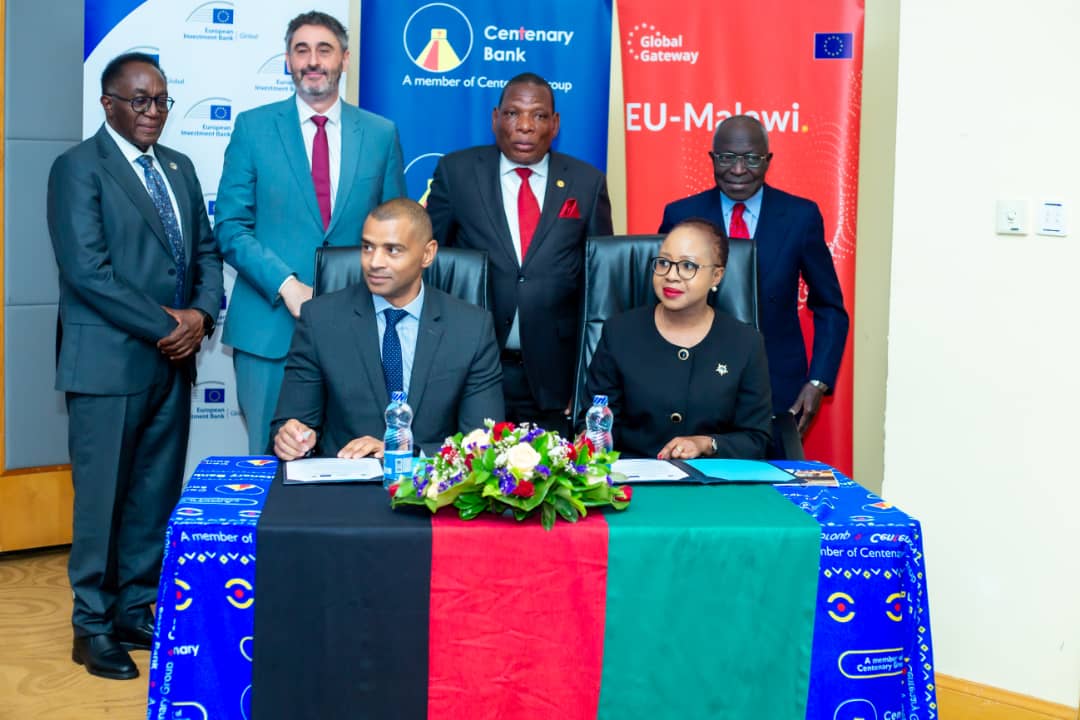
Centenary Bank Malawi and the European Investment Bank (EIB) have signed a EUR 7.5 Million (MK15.1 Billion) financing agreement aimed at empowering micro, small and medium enterprises (MSMEs) in Malawi.
The signing ceremony took place on Tuesday, 15th September 2026 at the Bingu International Conference Centre (BICC) in Lilongwe.

Speaking after the event, Minister of Finance, Economic Planning and Decentralisation Hon. Joseph Mwanamvekha said the agreement is important not only to the bank but to government and Malawians, particularly SMEs.

”The agreement that they have signed today is quite important. It is intended to empower our SMEs in order to do business and also to improve their funding. As you are aware the economy depends on agriculture,” said Mwanamvekha.
Mwanamvekha stressed the need to minimize bureaucracies and ensure competitive pricing so that people without traditional security can benefit, adding that empowering SMEs is empowering the economy.
”Any economy to develop, it depends on the medium and small enterprises,” he said.


EIB Head of Southern Africa Regional Hub Jim Hodges said the deal is a fantastic opportunity for EIB to be back in Malawi.

”For us agriculture is a critical part of all the economies in the region and particularly in Malawi, for us to be in funding and investing,” said Hodges.
He said the facility is conditioned to reach agriculture businesses and micro and medium-sized businesses, with a cross-cutting focus on women and youth, and will offer longer-term tenors for smallholder farmers.
On her part, Centenary Bank Acting Managing Director Beatrix Mosiwa described the partnership as a great milestone for the bank.

”With this intervention of 7.5 million euros, it takes us a step further to reach out to more groups. So more women entrepreneurs, the youth and also those medium and small enterprises that are involved in agricultural financing,” said Mosiwa.
Meanwhile, Centenary Bank says the facility will target the lower part of the pyramid, reaching between 1.5 to 2 million people through a group collateral model where clients in groups of 10 to 15 guarantee each other, plus a financial literacy component.
By Jonathan Mzumazi.